
Social Studies
In RIDE’s vision for student success in social studies, Rhode Island students will understand the world in which they live and will be prepared with the knowledge and skills to become informed, thoughtful, and active citizens in a culturally diverse democratic society and complex world.
Additionally, Rhode Island students will be civic ready upon graduation. A civic ready student has a strong knowledge of history, democratic processes, citizens’ rights and responsibilities, critical thinking and problem-solving skills, and is empowered to actively advocate and participate in their community. A civic ready student values having a range of perspectives, diverse communities, and promoting inclusion and equity in civic spaces.
A comprehensive K–12 social studies education builds historical understanding, cultural awareness, literacy, and critical thinking while helping students understand geography, economics, and their role in society. Social studies prepares students for engaged participation in college, career, and civic life.
Please see the tabs below for Rhode Island’s three primary social studies guidance documents—the Rhode Island Social Studies Standards, the Social Studies Curriculum Framework, and the Civic Learning Guidebook—along with curricular and instructional resources and tools to support their implementation.
Rhode Island Social Studies Standards
Revised Rhode Island Rhode Island Social Studies Standards were endorsed by the Council for Elementary and Secondary Education in February 2023. LEAs are working toward making their shifts to align with the new Standards. Shifts should be completed for full implementation of the new Standards by the 2026-2027 school year.
The full Standards document is available for download in PDF format:
- Rhode Island Social Studies Standards (Full PDF Document, February 2023)
The Standards document is also broken into segments for easier access below:
- Introduction
- Anchor Standards
- Content Standards Overview and Grade Progressions
- How to Read Content Standards
Kindergarten – Grade 8
- Kindergarten – Living and Working Together in Schools, Families, and Neighborhoods
- Grade 1 - Living and Working Together in Local Communities
- Grade 2 - Living and Working Together in Global Communities
- Grade 3 - Living and Working Together in the Regions of the United States
- Grade 4 - Living and Working Together in Rhode Island
- Grade 5 - United States History: Pre-European Contact to Reconstruction
- Grade 6 - Ancient to Medieval World History and Geography
- Grade 7 - Early Modern to Modern World History and Geography
- Grade 8 - Government and Civic Life in the United States and Rhode Island
High School
- Civics
- United States History I: Pre-European Contact to Reconstruction
- United States History II: Late 19th Century to the Present
- World History I: Ancient to Medieval
-
World History II: Early Modern to Modern
Informational Slides and FAQs
Social Studies Standards Informational Session Recording (May 2023)
Social Studies Standards Slide Deck This slide deck can serve as a turnkey, ready-to-use presentation and includes a facilitator script.
Social Studies Standards FAQs (Last updated in January 2025)
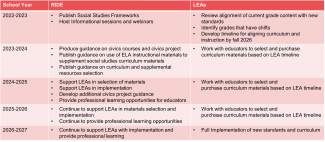
The Social Studies Curriculum Framework provides guidance around the implementation of the Rhode Island Social Studies Standards, particularly as it relates to the design and use of curriculum materials, instruction, and assessment.
Social Studies Curriculum Framework
Informational Slides and Recordings
The Curriculum Framework informational session recording is broken into sections below. (posted May 2024)
- Section 1: Introduction (Length – 9:40)
- Section 2: Implementing High-Quality Curriculum (Length – 19:51)
- Section 2a: Implementing the Standards in the Elementary Grades (Length – 8:16)
- Section 2b: Implementing the Standards in the Middle Grades (Length – 5:47)
- Section 2c: Implementing the Standards in High School (Length – 10:23)
- Section 3: Implementing High-Quality Instruction (Length – 13:51)
- Section 4: High-Quality Learning Through Assessment (Length – 15:42)
This slide deck can serve as a turnkey, ready-to-use presentation and includes a facilitator script.
The Civic Learning Guidebook provides a comprehensive approach to integrating Civic Learning Practices into instruction from kindergarten through high school, offering practical strategies to make civics a relevant, authentic, and cohesive part of the social studies curriculum. It also outlines clear expectations and guidance for implementing civic action projects, including the Civics Capstone required for graduation.
Civic Learning Guidebook: Instructional Guidance for All Teachers (Fall 2024)
Civic Learning Guidebook Information and FAQs
Civic Learning Guidebook Informational Session Recording (Fall 2024)
Civic Learning Guidebook Slide Deck This slide deck can serve as a turnkey, ready-to-use presentation and includes a facilitator script.
Civic Learning in Rhode Island FAQs
To support Local Education Agencies (LEAs) in selecting standards-aligned, high-quality core curricular materials in social studies, RIDE conducted state-supported reviews to help LEAs make their adoption decisions. LEAs are not required to select materials that have been reviewed through RIDE’s review process.
Materials reviewed by RIDE were submitted by vendors through a Request for Curriculum and reviewed by teams of Rhode Island educators. The reviews linked below are those that were found by review teams to have met the minimum requirements for consideration by districts. While RIDE staff may have edited reviews for clarity, the findings reflect the views of the review team members and are intended as guidance only.
LEAs are encouraged to conduct their own reviews of the materials prior to final adoption using the following RIDE-developed tools:
- Social Studies Review Tool for Selecting High Quality Curriculum Materials
- Guide for Assessing Curriculum Materials in Social Studies for High Quality
Educators should be able to receive preview access to materials by contacting the vendor directly.
For additional details about the review process and phases of the work, please refer to:
Review Reports of Recommended Curricula by Grade and Course
To support Local Education Agencies (LEAs) in implementing high-quality curriculum materials (HQCM) in social studies, RIDE has established a list of approved core and supplemental curriculum providers as well as professional learning providers. These vendors hold statewide contracts through the Department of Administration’s Master Price Agreement (MPA) process and are available under MPA 636.
In addition, RIDE has identified approved providers of curriculum-based professional learning across content areas, including vendors approved to support social studies curriculum implementation. These providers are available under MPA 581.
Please note that MPA 636 and MPA 581 used different selection criteria during the review process, with MPA 636 focused specifically on social studies.
LEAs may opt in to agreements with vendors listed under either MPA and initiate purchase orders through the Rhode Island Division of Purchases Contract Board. LEAs are encouraged to review the respective User Guides to determine how these partners can support their social studies curriculum and professional learning priorities.
MPA 636 - High Quality Curricula and Professional Learning in Social Studies
MPA 581 - High Quality Curriculum-Based Professional Learning
Summary of Approved Vendors

Unpacking the Social Studies Standards
Unpacking a Compelling Question from the Standards (Fillable Document) – This tool supports unpacking an Inquiry Topic’s Compelling Question from the Rhode Island Social Studies Standards to inform unit planning and the unpacking of individual standards.
Standards Unpacking Template (Fillable Document) – This fillable template guides educators through unpacking a standard to inform lesson planning.
Standards Unpacking Example - Elementary Grades – This document provides an example of unpacking a grade 4 standard.
Standards Unpacking Example - Middle Grades - This document provides an example of unpacking a grade 7 standard.
Standards Unpacking Example - High School - This document provides an example of unpacking a standard from the high school World History II course.
Connecting Social Studies to Other Core Content Areas
Social Studies Standards and English Language Arts HQCM - This document serves as a crosswalk between some commonly used ELA HQCM (CKLA, EL, and Wit and Wisdom) and the Rhode Island Social Studies Standards for grades Kindergarten to eight, where connections are applicable, to help teachers make connections during instruction.
Social Studies Standards and Core Standards for Mathematics – This document outlines correlations and connections between Rhode Island’s social studies standards and the Rhode Island Core Standards for Mathematics.
Social Studies Standards and Next Generation Science Standards - This document outlines correlations and connections between Rhode Island’s social studies standards and the Next Generation Science Standards.
Assessing Curricular Materials
Guide for Assessing Curriculum Materials in Social Studies for High Quality – This protocol guides review teams in evaluating core social studies curriculum materials under consideration for adoption. To be used with the review tool posted below.
Social Studies Review Tool for Selecting High Quality Curriculum Materials (PDF) – This tool can be used to assess both core and supplemental social studies curricular materials.
Social Studies Review Tool for Selecting High Quality Curriculum Materials (Fillable Document)
Assessing Student Performance on the Standards
Rubric Template and Examples for Assessing Student Performance on the Rhode Island Social Studies Standards (PDF) – This document provides strategies for using the Rhode Island Social Studies Standards to create assessment rubrics that track student progress on one or more standards within an inquiry topic.
Rubric Template and Examples for Assessing Student Performance on the Rhode Island Social Studies Standards (Fillable Document)
Walkthrough Guidance and Tool
RIDE Guide to HQCM Instructional Walkthroughs - Instructional walkthroughs are non-evaluative, structured classroom visits designed to understand how High-Quality Curriculum Materials (HQCM) are enacted implemented skillfully in real classrooms.
Social Studies Walkthrough Tool - The Social Studies Walkthrough Tool articulates the vision for skillful social studies teaching and learning. Purposes for use include: 1) preparing lessons; 2) reflecting on instructional practices; 3) developing professional learning on standards-aligned practice; and 4) providing feedback on classroom practice.
Social Studies Walkthrough Tool Companion Guide - This document provides observational questions—or example "look-fors"—designed to support the identification and recognition of high-quality social studies instruction. These look-fors are intended to make abstract teaching indicators more concrete by offering examples of what effective practices might look like in action within a classroom setting.
Guiding and Assessing Civics Action Projects
Below are resources developed by RIDE to support educators in implementing civics action projects. Please also refer to the Civic Learning Guidebook for additional instructional tools and resources for facilitating and assessing civic action projects as well as for each of the Civic Learning Practices.
Civics Project Planning Template (Fillable Document) - Use this document to align student-led civics projects with the expectations in RIDE’s Civic Learning Guidebook. The template will help you map student tasks, teacher support, and classroom activities, including assessments, to each project phase. Refer to the Civics Project Planning Examples document as you complete the template.
Civics Project Planning Template (PDF – for Printing)
Civics Project Planning Examples – This document includes two sample project outlines. Each maps student tasks, teacher supports (including assessment suggestions), and helpful tools to RIDE’s six student-led civics project phases. Use the examples to plan how you will guide your students through each phase based on your own timeline using the Civics Project Planning Template document.
Civic Action Project Rubrics – This document includes a Taking Informed Action Project and a Civics Capstone Project Rubric. These rubrics follow a single-point format, which means they focus on key expectations for each project phase.
Stay informed about social studies – related information through the Rhode Island Social Studies Newsletter. Issues are regularly published on the first Thursday of the month with some exceptions. Newsletter entries include professional learning opportunities, conference announcements, open-source teaching resources, information to join academic competitions, enrichment ideas, opportunities to share with students, and other items that are specific to Social Studies or related disciplines.
- Sign up to receive the RIDE Social Studies Newsletter
- Newsletter submissions should be emailed to socialstudies@ride.ri.gov. Please review the submission guidelines in this document. Submissions that do not meet the guidelines will not be published.
- View the RIDE Social Studies Newsletter Archive to review previous newsletters
Questions can be directed to: Social Studies
Members of the Rhode Island History & Social Studies Advisory Committee (RIHSSAC) advise RIDE on civics and social studies education and serve as a liaisons to the broader education community. The committee also functions as a working group for key initiatives, such as the development of the revised Social Studies Standards, Curriculum Framework, and Civic Learning Guidebook.
For more information on the RIHSSAC, please email: socialstudies@ride.ri.gov
RELATED LEGISLATION
- Civics Education – RIGL §16-22-2
- Genocide and human rights education – RIGL §16-22-22
- Statewide Education Standards - RIGL §16-22-30
- Curriculum Frameworks - RIGL §16-22-31
- Holocaust and Genocide Education in Secondary Schools – RIGL §16-93
- African American History Education in Elementary and Secondary School – RIGL §16-110
- Asian American, Native Hawaiian and Pacific Islander history study – RIGL §16-22-36